
Reading X-ray Absorption Spectra
An X-ray absorption spectrum looks simple at first: tune the photon energy and record how strongly a sample absorbs. Yet one scan can say which element absorbed the photon, which core orbital the electron left, how that atom is bonded, and how its neighbors are arranged. The trick is that different parts of the spectrum speak different dialects.
Experimentally, the absorption coefficient follows the Beer-Lambert law,
where $t$ is the sample thickness. Microscopically, absorption promotes a localized core electron into an unoccupied state. For an $N$-electron system in the electric-dipole approximation,
This compact expression already contains most of XAS. The initial state $\lvert\Psi_0^N\rangle$ contains the occupied core orbital, the many-body final states $\lvert\Psi_F^N\rangle$ contain the excited electron and the core hole, and the polarization $\boldsymbol{\epsilon}$ selects orbital directions. Element specificity comes from choosing which localized core orbital is excited.
What does “Cr K-edge” mean?
The two parts specify different things:
- Cr is the absorbing element. The excitation begins on a chromium atom, even if the final state is strongly hybridized with oxygen or another neighbor.
- K labels the initial core shell: K means $1s$. Likewise, $L_1$ means $2s$, while $L_2$ and $L_3$ are the spin-orbit-split $2p_{1/2}$ and $2p_{3/2}$ shells.
Thus the Cr K-edge is the onset of transitions out of a Cr $1s$ core state, near 5989 eV for elemental chromium. The precise edge position is not universal: oxidation, screening, and local bonding shift it, which is why edge shifts are often used as oxidation-state fingerprints.
For a dipole transition, $\Delta l=\pm1$, so the strongest Cr K-edge channel has $1s\rightarrow p$ character. A weak $1s\rightarrow3d$ pre-edge feature can still appear through electric-quadrupole coupling or through $3d$-$4p$ mixing when local symmetry allows it. In other words, the edge name identifies the starting shell, not a single destination orbital.
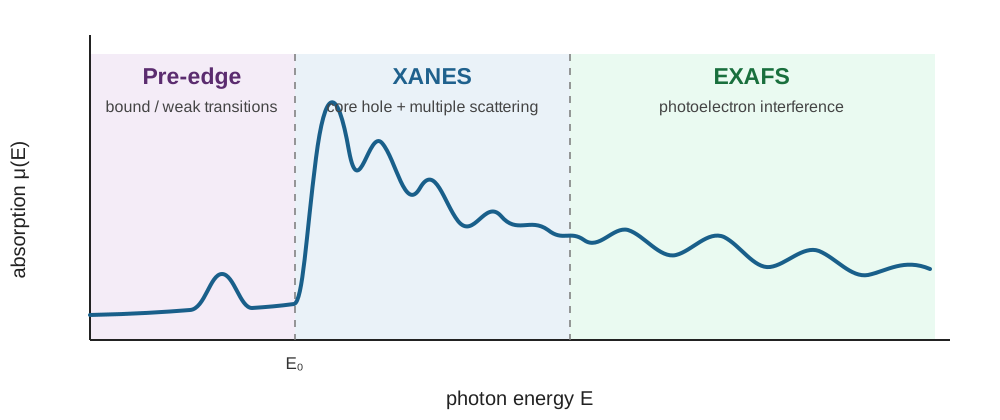
The three regions
1. Pre-edge: the quiet features with loud implications
The pre-edge lies just below the main threshold. Its peaks correspond to bound or quasi-bound final states and are usually much weaker than the main edge. Because their intensity depends strongly on selection rules and local symmetry, they can reveal oxidation state, spin state, coordination geometry, and inversion symmetry.
For a transition-metal K-edge, a centrosymmetric octahedral site often has a weak $1s\rightarrow3d$ pre-edge. Distortion or tetrahedral coordination mixes metal $p$ character into the $d$-dominated states, making the same feature dipole-accessible and much stronger. This is a good reminder that XAS is not simply an unoccupied density of states: matrix elements decide what becomes bright.
2. XANES: the near-edge many-body neighborhood
XANES (X-ray absorption near-edge structure), roughly the first 30-50 eV above $E_0$, contains the edge jump, possible white line, and several resonances. Here the photoelectron has a long wavelength and scatters strongly from several nearby atoms. At the same time, the positively charged core hole attracts the excited electron and can form a core exciton. Both multiple scattering and electron-hole correlation can matter.
This region is especially sensitive to oxidation state and coordination geometry. Higher oxidation often shifts an edge upward, but the line shape also depends on covalency, screening, spin-orbit coupling, and experimental broadening. A peak should therefore not be assigned from the projected density of states alone.
3. EXAFS: a local interferometer
Farther above the edge, usually beyond about 30-50 eV, the excited electron behaves more like a propagating photoelectron. Its outgoing wave scatters from neighboring atoms and returns to interfere at the absorber. Converting energy to photoelectron wave number,
exposes the oscillatory fine structure. A standard single-scattering expression is
Each neighbor shell $j$ contributes through its coordination number $N_j$, distance $R_j$, scattering amplitude $F_j$, disorder $\sigma_j^2$, and phase shift $\delta_j$. The mean free path $\lambda$ damps long trajectories, while $S_0^2$ accounts for many-electron amplitude loss. Fourier transforming $k^n\chi(k)$ produces peaks near coordination-shell distances, but phase shifts mean those peaks are not uncorrected radial-distribution functions.
Which method is reliable in which region?
The energy boundaries are approximate, and an unusually strong exciton can move them. Still, this is a useful working map.
Pre-edge and the first 10-20 eV above $E_0$. Bound states, core excitons, dipole-forbidden channels, and multiplets are most visible here. exciting provides an all-electron core-level BSE treatment when peak positions and oscillator-strength transfer matter. VASP also offers core BSE and a cheaper supercell core-hole route; XSpectra in Quantum ESPRESSO provides a core-hole DFT route. Real-time TDDFT in Octopus is possible only when the target core states are represented explicitly. A pseudopotential that freezes the relevant core shell cannot produce its absorption edge.
Main XANES, roughly 10-50 eV above $E_0$. Several-scattering paths overlap and the photoelectron wavelength is comparable to interatomic distances. FEFF with self-consistent potentials and full multiple scattering is a strong default for K-edge structure and rapid comparison of many candidate geometries. XSpectra in Quantum ESPRESSO and supercell core-hole calculations in VASP provide plane-wave alternatives that include valence relaxation around a static core hole. If those approaches miss a sharp onset, white line, or strong intensity redistribution, move to core BSE in exciting or VASP rather than merely shifting the energy axis.
EXAFS, normally beyond about 50 eV. The path expansion is controlled because the photoelectron wavelength is short and inelastic damping suppresses very long paths. FEFF is the natural choice: it generates the scattering amplitudes and phases for individual paths and sums them into $\chi(k)$. This is the most quantitatively reliable region for extracting bond lengths and disorder. Coordination numbers are less independent because they correlate with $S_0^2$ and $\sigma^2$. BSE, TDDFT, and explicit empty-band sums in VASP or Quantum ESPRESSO are unnecessary and inefficient for hundreds of eV of EXAFS oscillations.
Transition-metal $L_{2,3}$ and rare-earth $M$ edges need an extra warning. The $2p$ or $3d$ core spin-orbit splitting and open-shell multiplets can dominate even if the photon energy is high. An all-electron BSE calculation in exciting can resolve core spin-orbit channels. VASP’s current XAS implementation includes spin-orbit coupling in valence and conduction states but not the core-level splitting, so it does not separately reproduce $L_2$ and $L_3$. Strong localized-shell multiplets may remain difficult for all five packages considered here. “Near edge” is therefore a statement about energy relative to that edge, not about hard versus soft X-rays.
From the exact many-body spectrum to a Green’s function
Let $E_\gamma=\hbar\omega$ be the photon energy, $n_{\rm abs}$ the number density of equivalent absorbers, and $\alpha$ the fine-structure constant. In atomic units, the dipole absorption cross section is
Here $\lvert\Psi_0^N\rangle$ is the interacting ground state, $\lvert\Psi_F^N\rangle$ is an exact final state with one core hole, and $\hat D$ is the many-electron dipole operator. Using $\delta(x)=-\pi^{-1}\operatorname{Im}(x+i0^+)^{-1}$ converts the explicit sum over final states into a resolvent:
$\hat H$ is the full electronic Hamiltonian. The positive broadening $\Gamma$ represents the core-hole lifetime, photoelectron lifetime, instrumental resolution, or a convolution of them; formally one takes $\Gamma\rightarrow0^+$. This equation is still exact. Its propagator is a many-body electron-hole response, so core excitons, multiplets, shake-up, and shake-off channels are present if the final states are solved exactly. FEFF, TDDFT, and BSE differ mainly in how they approximate this propagator.
FEFF: a one-photoelectron Green’s function
FEFF reduces the many-electron resolvent to a quasiparticle moving in the potential of the nuclei, the other electrons, and a screened core hole. If $\phi_c$ is the selected core orbital and $d=\boldsymbol{\epsilon}\cdot\mathbf r$ is its one-electron dipole operator, the working form is
$E=E_c+E_\gamma$ is the final one-electron energy in the code’s energy convention, $h_{\rm ch}$ is the effective Hamiltonian including the screened core-hole potential, $\Gamma_c$ is the intrinsic core-level width, and the complex self-energy $\Sigma(E)$ describes quasiparticle shifts and inelastic losses. Its real part moves spectral features; its imaginary part limits the mean free path. The matrix element projects the full final-state propagator onto waves that can be launched from, and return to, the absorbing atom.
FEFF builds $G^R$ in real space from single-site scattering matrices $t_i$:
$G_c$ propagates in the central-atom reference potential, and each $t_i$ scatters the photoelectron from site $i$. Near the edge, FEFF sums this series by a full multiple-scattering matrix inversion over a finite cluster. At high kinetic energy it reorganizes the same series into geometrical paths, which leads to the EXAFS equation above.
The efficiency comes with identifiable approximations: a one-active-electron or sudden picture; self-consistent but usually spherical muffin-tin scattering potentials; a static screened core hole; model or many-pole $GW$-like self-energies; phenomenological or calculated lifetime and vibrational damping; and an amplitude factor $S_0^2$ for spectral weight lost to many-electron channels. FEFF therefore handles continuum propagation and EXAFS exceptionally well, and often gives useful K-edge XANES, but it does not explicitly diagonalize a correlated electron-hole Hamiltonian. Deep bound excitons, strong charge-transfer multiplets, and delicate pre-edge intensities are the places to be cautious.
This is also how the XAS data associated with the Materials Project were generated. The high-throughput workflow used crystal structures from MP, selected every symmetrically distinct absorbing site, built a local cluster, and ran FEFF9. The original release contained hundreds of thousands of site-resolved K-edge XANES spectra. So the MP curves are first-principles real-space multiple-scattering calculations—not TDDFT trajectories. They are excellent for comparing candidate structures and local environments, but finite-temperature disorder, defects, surface chemistry, and energy alignment can still separate a calculated ideal crystal from an experiment.
TDDFT: approximate the density-response kernel
TDDFT keeps the many-electron response at the density level. The interacting density-response function $\chi$ satisfies the Dyson-like equation
$\chi_s$ is the independent Kohn-Sham response, $v_C$ is the bare Coulomb interaction, and $f_{\rm xc}$ is the exchange-correlation kernel. Spatial integrations between neighboring factors are implicit. The polarization-resolved polarizability is obtained by projecting $\chi$ with the dipole operator,
In linear-response TDDFT, one commonly restricts the transition space to a chosen core orbital $c$ and unoccupied orbitals $a$. In the Tamm-Dancoff form,
$K^{\rm Hxc}$ contains matrix elements of $v_C+f_{\rm xc}$, so TDDFT shifts and mixes the bare Kohn-Sham core transitions. In a linear-response implementation, restricting the transition space to the selected core shell removes the enormous number of irrelevant valence excitations.
Octopus computes the same linear response in real time. After a weak impulsive field $\delta v_{\rm ext}(t)=-\kappa\,\boldsymbol{\epsilon}\cdot\mathbf r\,\delta(t)$, it propagates
and Fourier transforms the induced dipole,
One kick yields a continuous spectrum for that polarization. The cost is a very small time step for high-frequency core motion and a long propagation for fine energy resolution.
TDDFT’s weak point is now visible: the answer depends on $f_{\rm xc}$. Adiabatic semilocal kernels often underestimate core excitation energies, suffer self-interaction error, and poorly represent a long-range electron-core-hole attraction; they also miss genuine double excitations and many shake-up satellites. Core XAS in Octopus additionally requires an all-electron description or a pseudopotential that leaves the selected core shell active, together with a very small time step. It is not the normal tool for long-range EXAFS.
BSE: propagate an explicit electron-hole pair
BSE starts from single-particle orbitals, usually DFT states corrected toward quasiparticle energies by $GW$ or an approximate scissors/self-energy model. A core exciton $S$ is expanded in core-to-conduction transitions,
$c$ labels a localized core spinor, $a\mathbf k$ an empty Bloch state, and $X^S_{ca\mathbf k}$ the correlated transition amplitude. In the Tamm-Dancoff approximation the amplitudes obey
with
$K^d$ is the matrix element of the statically screened Coulomb interaction $W(0)=\epsilon^{-1}(0)v_C$ and attracts the excited electron to the core hole. $K^x$ uses the bare Coulomb interaction and describes exchange and local-field effects. Their off-diagonal elements mix independent transitions. The spectrum is
The amplitudes add before squaring. This coherent sum is why an exciton can borrow intensity, split a peak, or make a transition dark; a projected density of states cannot do that. $L_{\Gamma_S}$ is a normalized Lorentzian or other broadening function containing the core-hole width, excited-electron damping, and experimental resolution.
exciting solves core BSE in an all-electron LAPW framework. VASP reconstructs PAW core transition matrix elements and offers both $GW$-BSE and supercell core-hole workflows. Their main controlled errors are convergence with empty bands, $k$ points, screening cutoff, and transition subspace. Their physical approximations include static screening, usually the Tamm-Dancoff approximation, a quasiparticle picture, and incomplete vibrational or multi-electron satellite physics. BSE is generally the most systematic of these methods for bound core excitons and near-edge oscillator strengths, but it is more expensive than FEFF and is not designed for long-range EXAFS fitting.
A compact decision rule
- For a Cr K-edge oxide, begin with FEFF for geometry and broad XANES; compare VASP or Quantum ESPRESSO core-hole calculations when the self-consistent charge response matters.
- If the pre-edge or white-line intensity is central, use core BSE in exciting or VASP and converge the screening and transition subspace.
- Use Octopus TDDFT only when the target core shell is explicitly active and the time step resolves the core excitation energy.
- For bond lengths, coordination shells, and thermal disorder, use FEFF’s EXAFS path expansion.
- For Materials Project XAS, remember that the underlying method is FEFF real-space multiple scattering, not TDDFT or BSE.
Takeaway
XAS is local because the excitation begins in a compact core orbital. The pre-edge emphasizes symmetry and weak bound transitions; XANES emphasizes electronic structure, core-hole physics, and multiple scattering; EXAFS turns the photoelectron into an interferometer for neighbor distances and disorder. The regions overlap, but the change of language—from orbitals, to correlated near-edge states, to scattering paths—is what makes the whole spectrum readable.
References and starting points
- Materials Project: how its XAS spectra are calculated
- Mathew et al., high-throughput computational XAS
- FEFF documentation and theory overview
- Rehr et al., parameter-free X-ray spectra with FEFF9
- exciting tutorial: XAS using the BSE
- VASP XAS theory and tutorials
- Quantum ESPRESSO user guide (XSpectra)
- Octopus real-time TDDFT absorption tutorial
- Chromium edge-energy reference